

SEER “Season Energy Efficiency Index”
The Season Energy Efficiency Ratio (Seasonal Energy Efficiency Ratio) index is a numerical value that indicates the energy performance of air conditioning equipment and heat pumps. SEER is used as a standard measure to compare the energy efficiency of air conditioning equipment and heat pumps and is a key criterion when choosing new equipment or replacing old equipment.
The SEER index is calculated by dividing the amount of cooling or heating produced in a specific period of time (normally a cooling season) by the amount of electrical energy used in the same period. The SEER index is measured in units of BTU (British Thermal Unit) per watt hour. The higher the SEER number, the more efficient the equipment is.
SEER is mainly used in the United States and in countries that follow the United States’ energy efficiency standards. The index is very useful in places with a great variation in temperature throughout the year, since it is based on measurements made over a full-time period instead of point measurements.
The utility of the SEER index
The SEER index is not only useful for consumers, but it is also important for manufacturers and professionals in the air conditioning and heating industry. Manufacturers use the SEER index as a criterion to design more energy efficient equipment. Industry professionals can use the SEER index to provide recommendations on the type of air conditioning equipment or heat pump that best suits the customer’s needs.
The SEER index has also become a key criterion for government regulations and regulations related to energy efficiency. In the United States, air conditioning equipment and heat pumps must have a minimum SEER index to comply with the Environmental Protection Agency (EPA) energy efficiency standards.
Cost reduction
In addition, the SEER index is an important factor to consider when buying new air conditioning equipment or heat pump. A team with a high SEER index can be more expensive in the purchase, but it can save a significant amount of money on long-term energy costs. On the other hand, a team with a low SEER index can be more economical in the purchase, but it can result in higher long-term energy costs.
The energy and money savings that can be obtained with a high SEER air conditioner or heat pump compared to one with a low SEER will depend on several factors, such as the size and efficiency of the equipment, the frequency and duration of use, the climate and the electricity rate.
According to the United States Department of Energy, a window air conditioner with a SEER of 10 will consume around 30% more energy than a team with a SEER of 14. In monetary terms, if the average cost of electricity is €0.13 per kilowatt hour, you could save approximately €33 per year for every 1,000 hours of use of the equipment with a SEER of 14 compared to one with a SEER of 10.
In general, as the SEER index increases, greater energy and money savings can be achieved. For example, a team with a SEER of 16 can be 20% more energy efficient than one with a SEER of 14, which would translate into greater energy and money savings in the long term.
Other factors
Although the SEER index is an important criterion to consider when choosing new air conditioning equipment or heat pump, there are also other factors to consider. For example, the size of the equipment is an important factor that can affect energy efficiency. Too big or too small equipment may not be energy efficient and can result in higher energy costs.
Much more
than cold air...
air + water + Technology
Efficient | SUSTAINABLE | Economic
FAQs
No. It is a sustainable system with very low energy consumption and spends up to 80% less than an A/C. For example, for an area of 200 m2 the approximate consumption is 960 W at maximum speed.
between 7 ºC and 20 ºC less than that of outside air. It will depend on the daily weather conditions, mainly on the outside air temperature and its humidity. The hotter and drier the day, the more the evaporative air conditioners will cool down.
Yes, because an overpressure is generated that causes the cold air introduced to leave through the doors and open windows, Renewing the air, eliminating odors and preventing dust from entering the outside.
No, since its maintenance is minimal, due to the automation, they incorporate the equipment, such as an electrolytic detector of water quality, automatic and programmable drainage or automatic duct closure.
The installations are very fast, they would have the operating equipment in a short time and with their capabilities at 100%.
Because it allows you to save time and money, in addition to helping you cover a primary need such as air conditioning for general well-being in your company. Respecting the environment

Caudal:
20.000 m3/h
Cobertura:
+250 m2
Potencia (frío):
132 kW
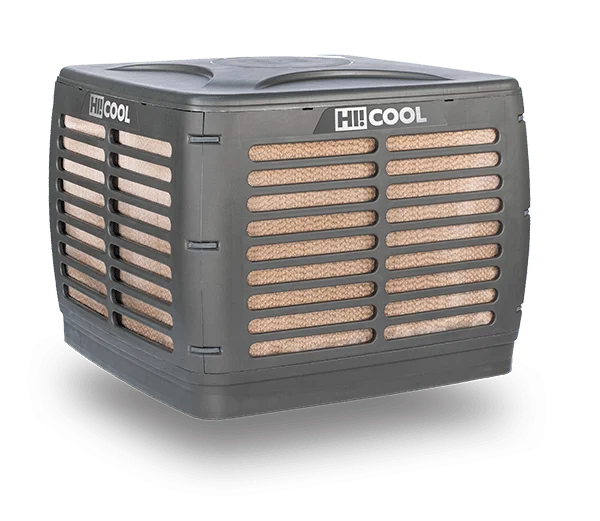

Caudal:
40.000 m3/h
Cobertura:
+500 m2
Potencia (frío):
247 kW
